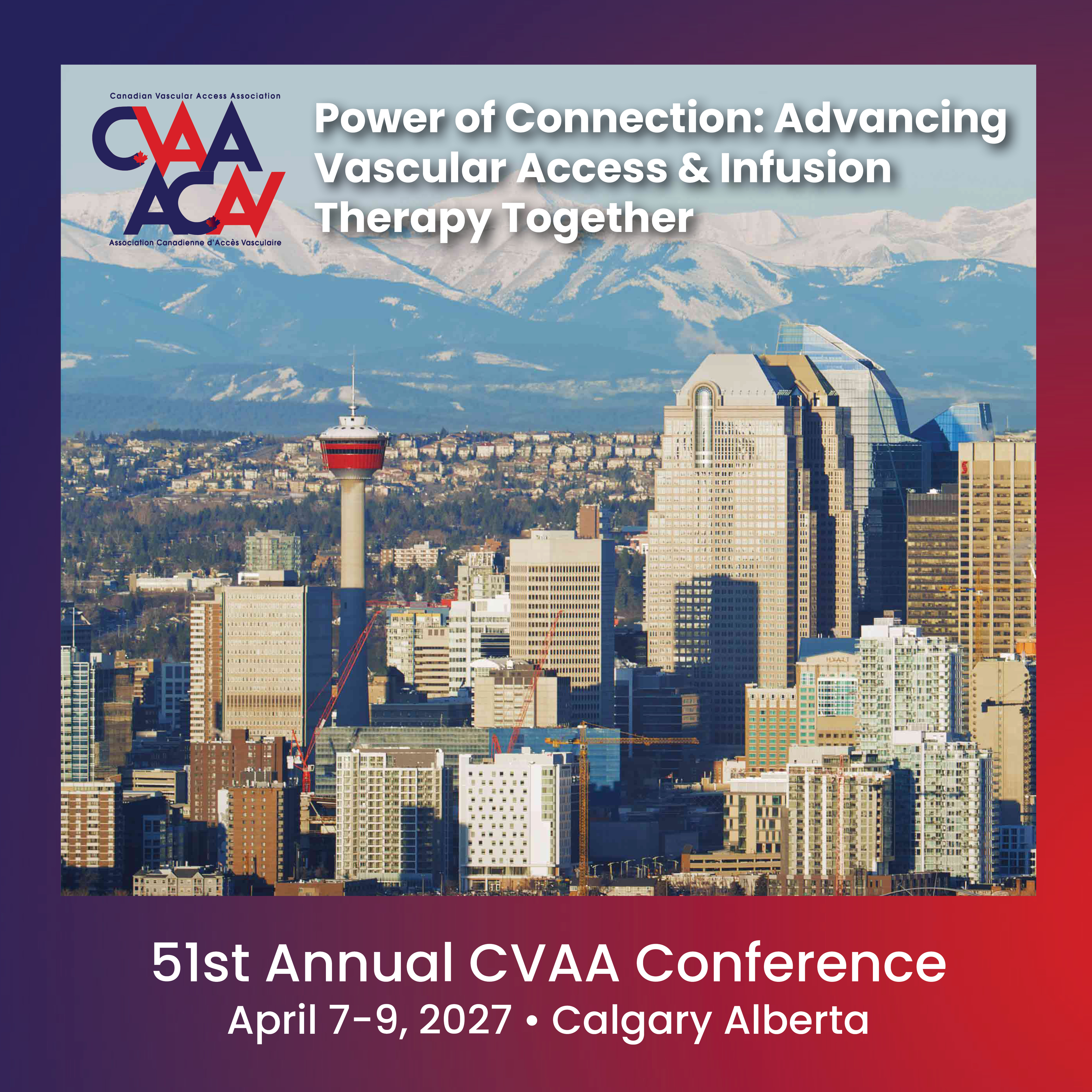
Power of Connection: Advancing Vascular Access & Infusion Therapy Together
Plan to join us in 2027 as we come together once again for our 51st Annual CVAA Conference.
April 7 - April 9, 2027
Calgary, AB
Hyatt Regency Calgary
700 Centre Street South, Calgary, AB T2G 5P6
Call for Abstracts
The 2027 CVAA Conference Committee invites you to submit an abstract for your plenary, concurrent, Skills Lab hands-on demonstration, or poster presentation at the 2027 CVAA Conference.
AND this year: we have also added an "Other" submission for any new ideas for education.
How to Submit
On September 8, 2026 the Call for Abstracts application opens. Complete the online forms below. All proposals must be submitted online. Please present enough details to evaluate the presentation; failure to do so adequately may result in rejection. Describe or outline topics presented, with enough detail for reviewers to fully understand the content proposed and the presentation strategies. Incomplete applications will not be considered for review.
Schedule
Date
|
Item
|
|
September 8, 2026
|
Call for Abstracts open
|
|
October 31, 2026
|
Submission deadline for abstracts 11:59 pm EST
|
|
December 4, 2026
|
Acceptance or rejection notification for all submissions
|
|
December 11, 2026
|
Presenter acceptance deadline
|
|
January 2027
|
Preliminary program available
|
Submission Categories
Plenary/Concurrent categories include: Research/Academic, Educational/Clinical Practice, Quality Improvement/Innovation specific to vascular access and/or infusion therapy. Topics should address the general or specific interests of CVAA members and conference delegates keeping in mind that CVAA is an organization of interdisciplinary clinicians and healthcare specialties involved in vascular access, infusion therapy and related fields.
Research abstracts must include results of the study at the time of abstract submission and confirmation of ethics review board approval.
We are always interested in implementation experience, quality improvement, or other topics that align with the current CVAA Guidelines. Preference will be given to those speakers who incorporate the CVAA Guidelines into their presentation.
Session Formats
Proposals are being accepted for the following formats: (see the Conference Content Guidelines here)
- Plenary Presentation: A 45-minute oral presentation followed by 15 minutes for questions and group discussion. Attended by all conference delegates
PLENARY SESSION
- Concurrent Presentation: A 30-minute oral presentation including questions and group discussion. Conference delegates choose from concurrent sessions
CONCURRENT SESSION
- Skills Lab Hands-On Demonstration: A 25-minute hands-on demonstration for a specific skill or technique. Each station must be run primarily by a clinician. Presenter must provide all supplies/products necessary. Presenters must select and present an Advanced or Novice session.
SKILLS LAB STATION
- Poster Presentation: A visual exhibit which will be displayed throughout the conference. At a conference event, the presenting authors will be required to stand with their posters to answer questions and engage in discussions with participants. Presenters must select Research, Case Study or Other.
POSTER PRESENTATION
- Other: We are open to considering new or additional education sessions or formats in this year's program. If you have a new idea, let's hear it!
OTHER SESSION
Selection Criteria
The following criteria will be used by the Conference Committee to select presentations, where applicable:
- Topic importance and current interest to the target audience, originality and innovation
- Clearly defined session objectives
- Introduction and project rationale is clear
- Results/findings
- Materials and methods
- Outcomes/findings are clearly stated and of importance to the target audience and may include protocols/tools for practice improvement
Abstracts may be rejected for any of the following reasons:
- Trade names of products, or devices are included in the submission
- People, facility, company, geographic locations are identified in the submission
- No results are identified
Scoring Rubrics
RESEARCH / ACADEMIC ABSTRACTS
1. Relevance & Significance: Importance of the topic to infusion therapy / vascular access practice and alignment with conference themes
2. Scientific Rigor & Methodology: Clarity and appropriateness of study design, methods, and analysis
3. Results & Data Quality: Clarity, completeness, and validity of results (data-driven, not anecdotal)
4. Interpretation & Impact: Strength of conclusions and relevance to clinical practice, policy, or future research
5. Innovation / Originality: Novelty of the research question, methods, or contribution to the field
6. Clarity & Organization: Logical structure, clarity of writing, and adherence to abstract format
________________________________________
EDUCATIONAL / CLINICAL ABSTRACTS
1. Relevance & Need: Importance of the topic to practice and identified gap in knowledge or care
2. Educational Design & Approach: Quality of teaching strategy, framework, or intervention design
3. Application to Practice: Practicality, usability, and relevance to clinical or professional settings
4. Impact & Outcomes: Demonstrated or anticipated impact on learners, practice, or patient care
5. Innovation / Engagement Strategy: Creativity and effectiveness of educational methods to engage learners
6. Clarity & Organization: Logical structure, clarity of writing, and adherence to abstract format
________________________________________
QUALITY IMPROVEMENT / INNOVATION ABSTRACTS
1. Relevance & Problem Definition: Clarity and importance of the practice gap/problem and alignment with conference themes
2. QI/Innovation Design & Methods: Appropriateness of QI methodology (e.g., PDSA, Lean, Six Sigma) or innovation approach; clarity of intervention
3. Implementation & Feasibility: Practicality, scalability, and description of implementation processes (barriers/facilitators)
4. Outcomes & Impact: Evidence of impact on processes, safety, efficiency, or patient/provider outcomes (data preferred)
5. Sustainability & Spread: Potential for sustainment, spread to other settings, or system-level adoption
6. Clarity & Organization: Logical structure, clarity of writing, and adherence to abstract format
|
Score
|
Description
|
|
5
|
Exceptional – high quality, clear, impactful, and well-supported
|
|
4
|
Strong – above expectations with solid evidence and clarity
|
|
3
|
Good – meets expectations with adequate detail
|
|
2
|
Fair – some strengths but limited clarity, rigor, or impact
|
|
1
|
Weak – lacks clarity, detail, or relevance
|
|
0
|
Not addressed
|
Presenter Benefits
CVAA will provide the following benefits to selected presenters:
- Non-sponsored Plenary Speakers: honorarium in the value of $500 CAD, stipend for travel and/or accommodations in the value of $300 CAD, free day-of presentation conference registration OR 50% full conference registration
- Sponsored Plenary Speakers: free day-of presentation conference registration OR 50% full conference registration
- Non-sponsored Concurrent Speakers: honorarium in the value of $200 CAD, stipend for travel and/or accommodations in the value of $300 CAD, free day-of presentation conference registration OR 50% full conference registration
- Sponsored Concurrent Speakers: free day-of presentation conference registration OR 50% full conference registration
- Skills Lab Presenters: no reimbursement, stipends or registrations will be provided. Presenters must register for the CVAA conference.
- Poster Presenters: no reimbursement, stipends or registrations will be provided. Presenters must register for the CVAA conference.
Presenter benefits cannot be combined with any other benefits and are awarded per session, not per presenter. Sessions with more than one presenter will only receive one set of benefits to be divided as the presenters see fit. Presenters who are selected to present more than one session will only receive one set of travel/accommodation stipend. Also, local speakers will not receive travel/accommodation stipends.
Preferred Topics
Here is a list of recent suggestions from attendees about the type of content they would love to see at a future conference:
- Infusion clinics
- Pediatrics (and for those with learning disorders)
- Extravasation
- Healthcare associated bloodstream infections – PIV source
- Vein finders vs. ultrasound
- Follow-up on intraluminal care including locking solutions to reduce CLABSI and PIVBSI. Initiatives to safeguard our facility population using PIV and sub-cut lines and developing a resource guide and tools
- How to research
- Ultrasound guided PIV insertion
- Subcutaneous
- Infusions with monoclonal antibodies given in community not with pumps
- Tips and tricks for getting dial regulators to work well with PIVs on a gravity infusion if the rates on the dials can be seen as reliable as pumps
- Ports
- How can we better prepare our nurses with vascular access knowledge while in school with present state of healthcare system
- PICC line insertion, port-a-cath, VAST team programs, PIVUS program
- Community care and end of life care
- Quality improvement
- Infusion therapy, biologics, oncologic administration, IPAC
- Teaching universities and colleges. How to train new nurses in IV therapy. Not just one day in the lab. Any programs developed in some universities worth replicating ?
- More advance skill stations for PICC inserters
- Complication and management of PICC.
- "Suggest perusing the new Guidelines table of contents as a jumping off point - there are topics in there!
- Intrigued by the SC fluids / meds mention"
- continued networking and cultural experiences, including home care setting
- Medical Lab Tech (MLT) and venipuncture vs blood draws from lines based on best practice and the guidelines. How line draws can impact results.
- Continue with education on nurse lead clinics - how to initiate etc
- Bridging hospital to community
- Make some sessions more applicable to front line workers who work with CVADs but do not insert them
- The presentations with real examples was beneficial. Perhaps presenting case studies, or unique vascular access situations and requirements for certain therapies- troubleshooting around those scenarios.
- For people who are brand new/first timers- perhaps a 101 session review. For example, some might not know what a catheter to vein ratio is, or basics of venous access."
- Would be nice to see less of PICC/USIV sessions as there's so many already, would be nice to see more informatics content, more new topics and things
- Securing/inserting piv on neonates (eg scalp) securing on compromised skin integrity (EB, burns)
- Nurse lead vascular access team expansions, reducing medial waste in vascular access, PICC and Central Line Stewardship programs (like antibiotic stewardship) to actively review and justify central lines daily to avoid unnecessary risk
- SC infusions / medications
- CVAD / PVAD complications – e.g. MARSI / catheter associated skin injury
- Intraosseous
- Vascular access and nursing informatics
- Would love some back to basics topics covered. A huge portion of attendees are community based nurses and we could benefit from some expert knowledge in that field. PICC insertion and ultrasound technology really overshadowed all other topics or potential for topics.
- Pediatric specific considerations would be amazing as well. Some PIVC tips and tricks. Maybe something case study based, techniques for trauma reduction. "
- Training and developing new nurses to PICC insertion and related therapies
- More on drug-specific infusion-related topics
Moderators for all sessions are selected by the CVAA Conference Committee.
Questions?
For assistance with questions regarding your abstract submission, please email cvaa@cvaa.info or call 1-888-243-9307.