Thank you for attending!
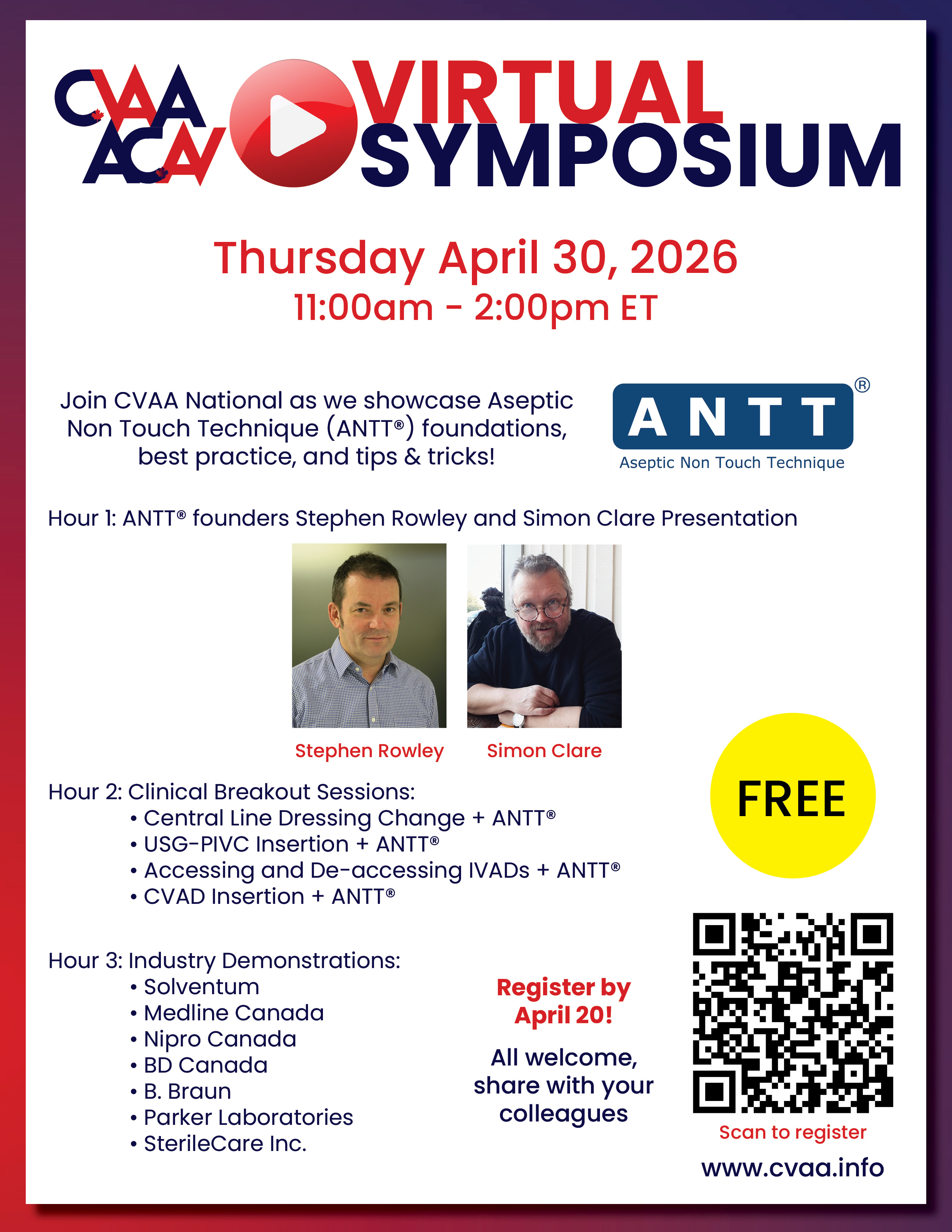
We had a wonderful turnout from around the world. Share your feedback here.
Hour 1: ANTT® founders, Stephen Rowley and Simon Clare present with Q&A
Recording can be found under Members' Area for CVAA National Members here.
Hour 2: Clinical Breakout Sessions:
Central Line Dressing Change + ANTT®
USG-PIVC Insertion + ANTT®
Accessing and Deaccessing IVADs + ANTT®
Central Line Insertion + ANTT®
Hour 3: Industry Demonstrations (not recorded)
Prep, Protect, Secure & Manage: Applying Solventum Solutions Using ANTT®
Visit Solventum here
This session will provide a practical review of how to effectively prep, protect, secure, and manage vascular access devices using Solventum solutions in alignment with ANTT® principles. Participants will gain a clear understanding of proper product application to support infection prevention and optimal vascular access device outcomes. The session will include a hands-on demonstration of Solventum products, followed by live Q&A to reinforce best practices and address real-world clinical questions.
Clinician Co-Created Ultrasound Guided Insertion Kit Bundle
Visit Medline here
Come join Jocelyn Hill and Medline for a hands-on demonstration of an ultrasound guided insertion kit combined with ANTT®. This unique ultrasound guided insertion kit bundle provides a step-by-step guide partnered with the components needed to support Staff with this practice. Also, this kit bundle provides an on the go sterile field that can easily be placed on an ultrasound cart, but most importantly encourages standardization of care and best practice.

Simplify the Stick, Extend the Dwell: USG-PIVC with Standard ANTT
Visit Nipro here
Ultrasound-guided PIVC is a game-changer for difficult access, but it can't come at the cost of aseptic integrity. Join this session to simplify the USG-PIVC procedure through the lens of Standard ANTT® rather than a complex surgical setup. Using an innovative guidewire-free long, soft-tip catheter and an integrated sterile gel barrier and dressing, combined with a compact screen-integrated ultrasound device, the entire procedure becomes a simplified, single-clinician workflow that protects Key Parts and Key Sites, supports Non-Touch Technique, and achieves longer dwell times.

Can’t Touch This – Peripheral Intravenous Catheter Insertion Using ANTT®
Visit BD here
An opportunity to review how you initiate a PIV to optimize your patient outcomes by applying ANTT® to every PIV start. We will show some products and techniques that will help make ANTT® possible and easy! Participants will be able to identify the key parts and key sites that must be protected and not touched during PIV insertion; describe best practice skin antisepsis for PIV site preparation, including antiseptic options, recognize common insertion habits that are inconsistent with ANTT® principles and apply corrective strategies and apply practical tips and techniques to successfully use ANTT® during challenging PIV insertions.

Protecting the Key Site Over Time: ANTT® Principles in Peripheral IV Maintenance
Visit B. Braun here
ANTT® does not end at insertion. This session examines how peripheral IV securement supports ongoing Key Site protection during maintenance by reducing catheter movement, manipulation, and unplanned removal. By preserving IV access and minimizing resticks, securement devices help limit new Key Sites and the potential for healthcare‑associated infections. An ANTT®‑focused virtual exhibit booth discussion.
Ultrasound-Guided Mastery in Practice: Precision, ANTT®, and Performance
Visit Parker Laboratories here
Ultrasound guidance has transformed vascular access practice, but achieving consistent mastery requires more than simply visualizing the vein. This session focuses on translating ultrasound knowledge into precise clinical performance through CVAA Guideline application with optimized technique, structured procedural steps, and strict adherence to ANTT®. Participants will review practical strategies for vessel assessment, needle visualization, and probe–needle alignment to improve first-pass success and reduce complications. The session will also explore the Three Stations of the Needle and key ultrasound needle signs that help clinicians confirm accurate needle position and guide advancement toward the target vessel. Maintaining procedural asepsis will be emphasized, including proper probe protection with sterile barriers such as the UltraDrape to protect the transducer and key procedural components. Attention will be given to protecting key parts and key sites while maintaining efficiency throughout the procedure. Attendees will leave with practical, evidence-informed techniques to strengthen ultrasound-guided vascular access performance and improve patient safety.
Catheter Locking Through an ANTT® Lens: Practice, Prevention, and the Role of Lock Solutions
Visit SterileCare here
This session will focus on catheter locking as a key but sometimes underrecognized component of catheter maintenance and complication prevention. Using an ANTT® framework, it will review best practices for preparing and instilling catheter lock solutions while minimizing touch contamination and variation in technique. The session will also address an important gap in current prevention strategies: although many catheter care measures are designed to reduce contamination at the point of central venous catheter insertion or access, fewer address the protection of the final potential portal of entry of microorganisms into the patient - the catheter lumen itself. This session will focus on how antimicrobial and anticoagulant lock solutions may help fill that gap by supporting patency and helping prevent complications such as occlusion, microbial colonization, biofilm formation, and catheter-related infection.